

Decoding Humanoid Laboring Robots: 1897 | 1920 | 2026
A brief history of the (motion) arts and sciences, robots, and labor dynamics, through a liberal arts lens, spanning the 19th - 21st centuries

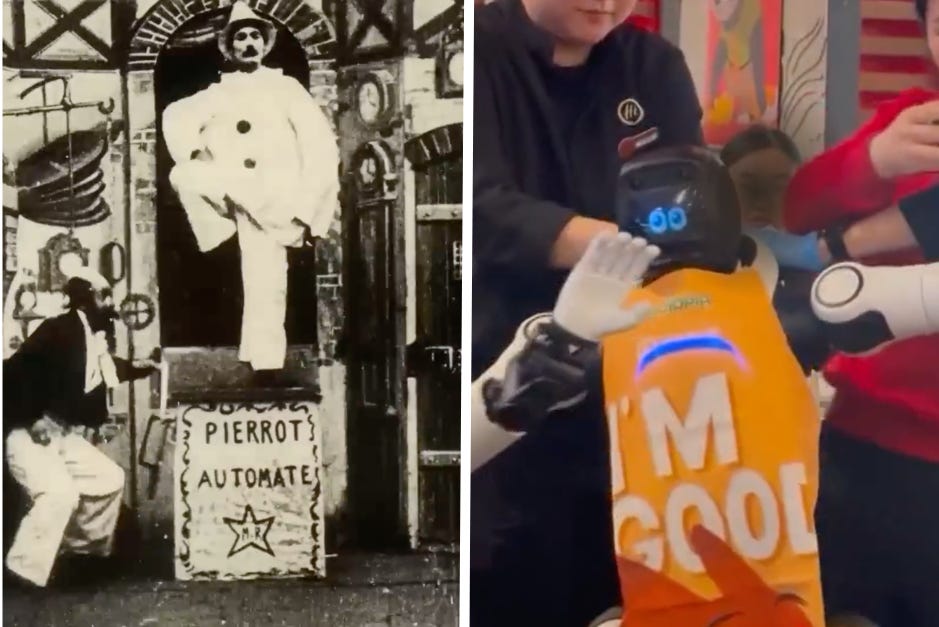
Aspects of the present and future of technology are riddled with old ideas.
Some are even rooted in encoded critiques on labor dynamics, which were crafted by pioneering storytellers of the late 19th and early 20th centuries.
This implies we can better understand technical and social dynamics, as they pertain to technology, like artificial intelligence, by better understanding human created stories—the humanities. Such is a liberal arts approach of study.
A Rediscovered Cinematic Clue
In February 2026, the Library of Congress’ National Audio-Visual Conservation Center announced a stunning discovery.
Long thought lost, a single-existing copy of Gugusse et l’Automate or Gugusse and the Automaton (1897), a short film by the French pioneer of film making, Georges Méliès, was discovered in the US.
The Center’s journey began in the autumn of 2025, after archivists received a box of donated old films to salvage and restore, from a Bill McFarland of Grand Rapids, Michigan. McFarland acquired the collection from his great-grand father, William Delisle Frisbee of western Pennsylvania, who was a potato farmer and school teacher by day, and a traveling showman by night.
It turned out that amongst the collection of films Frisbee traveled with, on his horse and buggy, along with his projector, was a copy of Méliès’ short film. By short, that’s 45-seconds, a feat of its time. Even for today, a bold and poignant narrative.
Before the actual film was recovered and restored, it had been regarded for decades as the first cinematic depiction of a mechanical figurine, which later would be described as a “robot.” The film’s nickname, The Clown and the Automaton, also preceded discovery of the film.
But now, we have the missing visual elements of Méliès’ story!
The Library of Congress’ summary of the film reads:
“Gugusse the clown appears to control the actions of Pierrot Automate, a child-sized automaton standing on a pedestal. By turning a crank, Gugusse makes him march and wave a stick. As Gugusse turns the crank, the automaton gets bigger until it is the size of a grown man…”
However, such a description seems to gloss over a deeper backstory and analysis. After reading though some of the US-based coverage on the discovery of the French film, it appears many are overlooking the significance of the film’s story. An interdisciplinary and multi-cultural understanding, as it pertains to art and science history, is key recovering what has fallen into the crevices of film history. It’s also key to identifying anachronistic markers tethered to the work as well.
A Comical and Mechanical Archetype
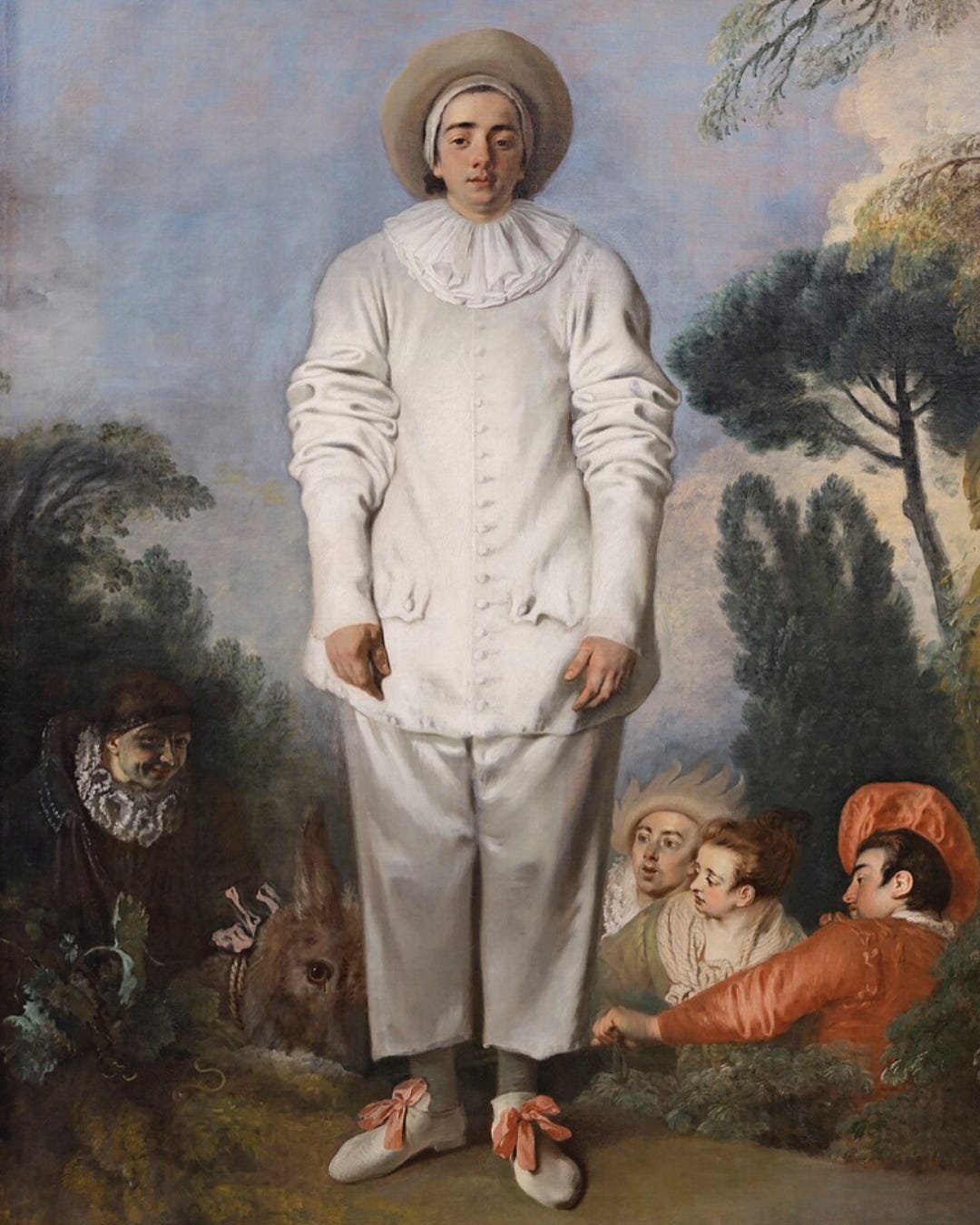
The 17th century French name Pierrot is derived from the Italian name Pedrolino, both diminutives of “Peter.” Yet, beginning in 16th century popular Italian culture, Pedrolino became a character archetype associated with that of a sad clown or the role of a “Zanni” in commedia dell’arte—“a comic servant” that indulges in “acrobatic antics and tricks” (per Merriam-Webster definition). He was depicted wearing oversized and ill-fit white garments.
With this backstory, I perceive Méliès’ Gugusse et l’Automate to be a more profound work of art than its receiving credit for.
It appears that the character Gugusse, depicted on frame-left in the film, is a regular human, not a clown, as the Library of Congress’ caption reads. If either Méliès, or members of his production team, earlier circulated text that identified Gugusse as a clown, hence the film’s nickname, it may be metaphorical. Gugusse as a clown could be interpreted as a critique of a man who created an automaton, in his image.
Another explanation could be that over history, non-French audiences heard the film regarded as The Clown and the Automaton, unfamiliar with the backstory attached to the French name, “Pierrot,” which is visible in the film. In this view, Pierrot and the Automaton are the same figure. Pierrot is the clown.
One of the world’s most revered museums, located in Méliès’ home city of Paris, France, holds a work of art that further supports my interpretation of his film. The Louvre recently hosted an exhibit that revolved around a painting by Jean-Antoine Watteau, Pierrot, known as Gilles (c.1718). “A New Look at Watteau” ran from October 2024 through February 2025, with the subtitle: “An actor with no lines.”
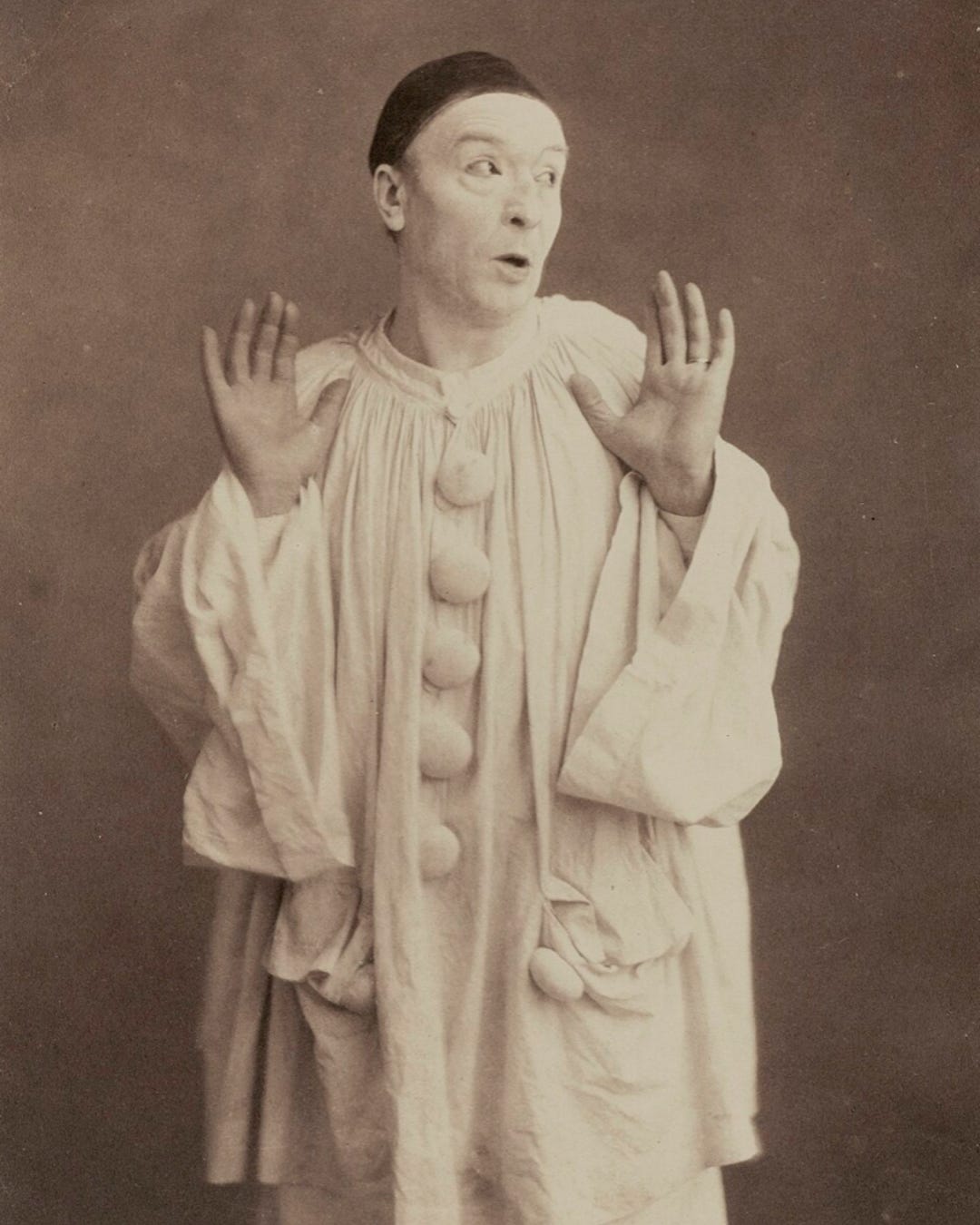
Over 130-years after Watteau’s painted the piece, Félix Nader’s photo of Paul Legrand as Pierrot the clown (c.1855), was taken. The new art form of photography continued to reinforce the cultural and labor association attributed to the archetypal Pierrot, he who played the laboring role of a clown for a patron.
From Automaton to Robot
Méliès’ motion picture, was created just over two decades after Nader’s still photo was taken. Not only did Méliès depict a visionary interpretation of the “Pierrot” archetype, his silent film appeared to speak volumes too.
The 1830s - 1910s were regarded as the “Golden Age of Automatons,” which are essentially mechanisms that are relatively self-operating. By the time Méliès created his story about an automaton, uniquely, he fused a story of a cultural archetype, “Pierrot,” to the mechanics and story of the automaton.
Viewers initially see Pierrot, as the clown / actor / servant / “Automate,” propped upon a box at the whim of Gugusse’s hands and command. Then, with motion picture artistry and technical skills, Méliès portrayed Pierrot’s autonomous resistance against Gugusse. In order to regain control over the older Pierrot, who grew in size, using a mallet, Gugusse reduced him back down to not only his younger version, but down to a metal humanoid, which we’d regard today as a “robot.” However, in an attempt to maintain control over the “robot,” Gugusse destroyed it too, all traces of Pierrot gone.
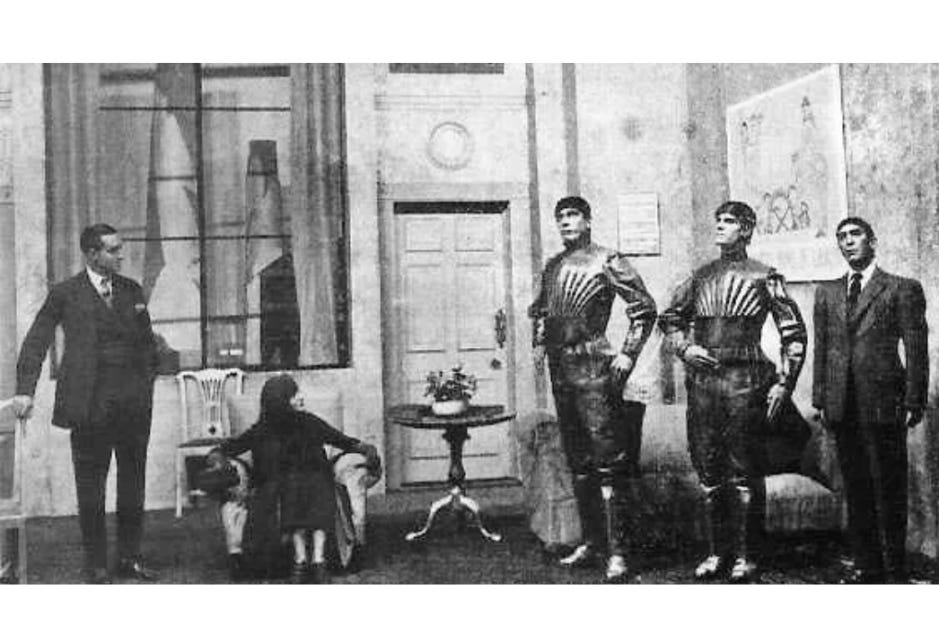
Here, it’s important to mention that it wasn’t until the 20th century that term “robot” was created. The idea for the word arose while the Czech playwright Karl Čapek was writing his play R.U.R. (1920), which is an initialism for “Rossumovi Univerzální Roboti” or “Rossum’s Universal Robots.”
During his writing process, Čapek sought the opinion of his brother, the painter and writer Josef Čapek, for he did not know “what to call [the] artificial workers” in his play, who had “developed intelligence, but…no soul,” nor passion, or will, and were made of a synthetic protoplasm that mimicked “living matter although its chemical composition was different.”
Čapek thought the term “Labori” was too bookish. When he approached his brother at his easel, to seek another name, with paintbrush in mouth, his brother replied, “Then call them ‘Robots,’” which derives from the Czech noun robot, meaning “worker.”
Performing Robots as Seen on Stages, IRL, and Digital Screens

February 2026 marked 88-years since the BBC aired what is regarded as the first science fiction TV program—a live recording of Čapek’s R.U.R. play. However, the anniversary did not garner celebration this year, overshadowed by other contemporary events happening in the present (e.g., the Federal Reserve’s commentary on a frozen labor market, AI cited as reasons for lay-offs, wars, prices of oil and gas, etc.,). Yet, a contemporary robot story captured social media and media outlet’s attention this past week, a dancing robot who overstepped.
Despite what some headlines written by media outlets implied, the dancing robot at a Haidilao Hot Pot restaurant in California did not go rogue.
Considered part of the restaurant chain’s smart dining system, technology has been embedded into the company’s approach for creating “fun” dining experiences. Not only does Haidilao have dancing robots, but robotic servers as well in some locations. Both types of robots operate on different programs.
After a customer requested a dancing robot dance closer to their table, chaos ensued. Since the dancing robot was preprogrammed, based on certain spatial proximity settings, when brought closer to people and other objects, it did what its programmed to do, dance. As a result, it carried out it choreographed motions, hitting the the table, food, and utensils in the process.
Adding to the chaos of banging and flying objects, several staff members were required to restrain the one entertaining robot, as it continued to dance. As captured in the footage, the human staff struggled to power-down the robot.
Some find the footage of the ordeal humorous. Others find it scary. I perceived it as a sad dark comedy, similar to that of the role of Pierrot, Pedrolino, Zanni, and the Labori of R.U.R.., laborers to do the job they were programmed to do.
Entertainment and labor come in various forms. Not all forms of entertainment are forms of the performance arts. Some are sheer forms of labor. Not all forms of labor are dignified, nor do all forms of labor need to be mechanized. Yet, markets and audiences are built for and around them.
Sources:
Adlakha, Siddhant. “The First-Ever Sci-Fi Film From 1897 Has Finally Been Rediscovered.” Inverse, March 8, 2026. https://www.inverse.com/entertainment/gugusse-and-the-automaton-georges-melies-short
Čapek, Karel. “About the Word Robot,” Translated by Norma Comrade. Lidove noviny As, December 24, 1933. https://scholarsbank.uoregon.edu/items/260c6922-cd5d-4a50-9eed-a1f068443c14
Čapek, Karel. R. U. R.(ROSSUM’S UNIVERSAL ROBOTS). Translated by Paul Silver and Nigel Playfair. Doubleday, Page and Company, 1923. https://www.gutenberg.org/files/59112/59112-h/59112-h.htm
Chen, Marcus. “Tech Layoffs 2026: How AI Is Driving the Biggest Workforce Shakeup in a Decade.” Tech Insider, March 19, 2026. https://tech-insider.org/tech-layoffs-2026-ai-workforce-impact/
Lewis, Danny. “78 Years Ago Today, BBC Aired the First Science Fiction Television Program.” Smithsonian Magazine, February 11, 2016. https://www.smithsonianmag.com/smart-news/78-years-ago-today-bbc-aired-first-science-fiction-television-program-180958126/
Méliès, Georges, Film Director, Actor. Gugusse et l’Automate. produced by Star-Filmuction Company, Film Distributor France: Star-film, 1897. Video. https://www.loc.gov/item/2026125501/.
“A New Look at Watteau: An actor with no lines: Pierrot, known as Gilles” Louvre, 16 October 2024 - 3 February 2025. https://www.louvre.fr/en/exhibitions-and-events/exhibitions/a-new-look-at-watteau
“Powell: Job creation is near zero.” Yahoo Finance. March 18, 2026. https://finance.yahoo.com/news/powell-job-creation-is-near-zero-202637723.html?guccounter=1
Tucker, Neeley. “Lost 19th century film by Méliès discovered at the Library.” The Library of Congress Blogs, February 26, 2026. https://blogs.loc.gov/loc/2026/02/lost-19th-century-film-by-melies-discovered-at-the-library/
Yip, Isabel. “Dancing robot busts a move, and dishes, after going rogue at California hot pot restaurant.” NBC News, March 19, 2026. https://www.nbcnews.com/news/us-news/dancing-robot-busts-move-dishes-going-rogue-california-hotpot-restaura-rcna264275
Veitman, Chloe. “Found: The 19th century silent film that first captured a robot attack.” NPR, February 28, 2026. https://www.npr.org/2026/02/28/nx-s1-5730373/georges-melies-robot-film-1897-library-of-congress-gugusse-automate
“Zanni.” Merriam-Webster Dictionary, accessed March 21, 2026. https://www.merriam-webster.com/dictionary/Zanni